
Write Once, Read Never
Do you ever re-read your journals? I don't. So why do I write them?

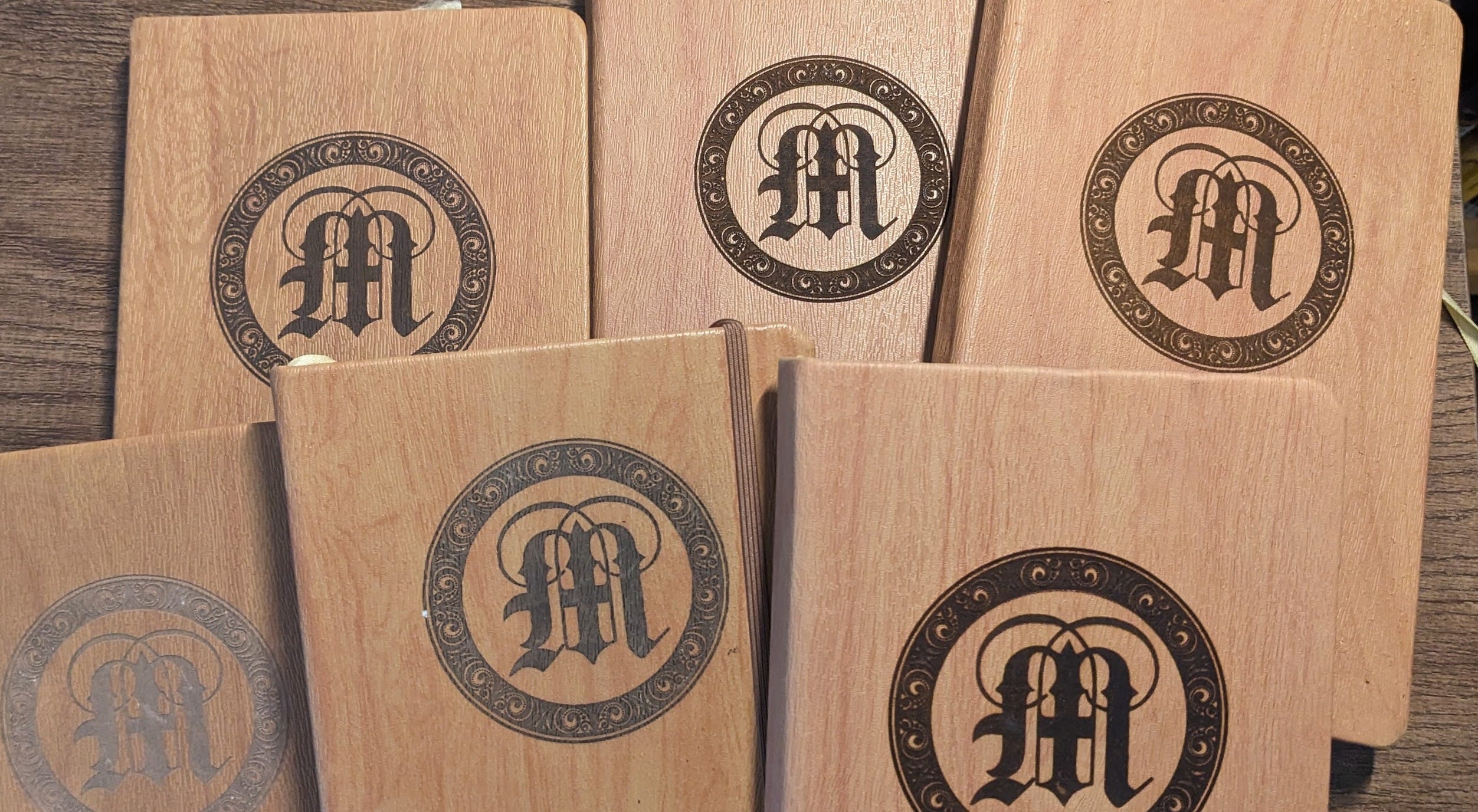
On the shelf to the left of my desk are six identical little books. Each has my initial printed on the front cover by a nice chap in Canada who I found on Etsy. Five of them are filled with assorted handwritten thoughts and observations dating back to 2018. At roughly 240 pages each, that’s almost 1500 pages of writing.
And I’ve never read them. I write stuff down, and then promptly forget about them.
Back in the days when I was first learning about computers and disk drives were a fancy new idea, we had the concept of a WORM drive - Write Once, Read Many. In other words, you’d record something, then you could refer to it as many times as you need. (Which, back then, was revolutionary.) My journals, however, are effectively a WORN drive - Write Once, Read Never. You record something, then you never look at it again.
Which, is, frankly, baffling. Why record something if you’re never going to look at it?
(Just to be clear, I’m not talking about my writing notes. Those live in a different set of notebooks, and I do go back to those.)
And this doesn’t just apply to journals. I have thousands of photos stored on my Google Drive. Maybe tens of thousands, I don’t know for sure. I don’t look at them. I take them, store them, and forget about them. I may perhaps share some of them, but not many. Most of them are almost identical copies of others: I may have taken fifteen or twenty photos of a chipmunk, trying to get a perfect shot, and then I keep all of them. I have countless shots of my models and artwork in various stages of completion. I have hundreds of pictures of the cats, usually lying in the same poses, in the same places. I have shots of our yard in every season, in every weather, mostly taken from the same viewpoints. Who cares? I don’t. I could delete 95% of them and I’d never miss them. Probably wouldn’t even know they were gone.
So why do we have this crazy urge to write things that nobody - including us - will ever see? Fundamentally it’s because, as Emily Ronay Johnston recently wrote in The Conversation, writing rewires the brain.

Focusing specifically on journals, I think there are four aspects to this.
(When it comes to the photos, that’s just laziness. There’s no pressure to delete the crap ones, and the cloud storage companies have a vested interest in encouraging us to keep everything and spend more money to store things we don’t need.)
The act of writing is therapeutic
It’s a well-established principle of talismanic magic that when you’re dealing with a problem, one of the most powerful ways to address this is to put your thoughts into a talisman, and then destroy it. You can burn it, bury it, throw it in the river, dissolve it in acid, whatever, but the whole point is that having put your mental energy into it, you get rid of it.
Therapists often recommend journaling for the same reason. By expressing your thoughts, your feelings, and your stresses to a page that can’t answer back, you’re letting those things out of you. And those things aren’t meant to be read. By writing them, you’re putting them behind you. You don’t need to revisit all that stuff. It’s not good for you. I’m not saying that my journals are full of negativity, but I do treat them as a way of venting. After I’ve written something, it’s often best just to let it go.
The act of writing clarifies your thinking
One of the most important things about writing is that you can’t just put down unformed half-assed ideas. (Well, I suppose you can, but then they just look like the rants of a crazy man.) You have to turn those ideas into words, and those words have to be organized into phrases, sentences, paragraphs, and a logical structure. In order to do that, you have to understand what you’re thinking and what you’re trying to communicate.
In other words, the actual written output doesn’t matter. What really matters is the mental effort that went into creating it, just as if you were writing a speech or preparing for a debate. Once you’ve gone through the process of constructing the piece, you’ve done what you set out to do. There’s no need to re-read it.
The act of writing helps you remember
Writing has one additional benefit: the process of putting something down in a written format seems to have a huge effect on long-term memory. We’re far more likely to remember something when we write it down. And, interestingly, writing by hand seems to be significantly more effective in this regard than writing on a computer or phone. (I’m not sure where typewriters fall on this spectrum, but it does appear that writing with a stylus on a tablet tends more towards the high recall end of things.)
So writing helps you not only understand something, but put it into your brain in a useful fashion. In all honesty, that’s a large part of why I write my blogs, not just this one, but Unhack Your Brain. It’s part of my own learning process: I write things so that I can make sense of them. And once I’ve learned them, why would I need to re-read them?
It would be like re-reading my old school history or geography notes. I recently discovered a big folder of school notes from 1975-82, or thereabouts. I ended up throwing them out. Who cares what I wrote down about Henry V 50 years ago? I don’t.
The act of writing creates something that can outlive you
But maybe, the person who will read my journals isn’t me. If you’ve ever come across the diaries of one of your ancestors, you’ll know just how fascinating it is to see a side of that person that you were never aware of. Things which seemed mundane to them may be revelatory to us. Or you can see how they reacted to the events of their time: I remember reading my great-aunt’s diaries, when she described growing up in the post-war recession - and that was the First World War. I had no idea how much she’d had to cope with.
So maybe my journals aren’t actually Read Never: they’re Read After I’m Gone. WORAIG - catchy, eh?
You've got me wondering about all the words I should be rereading. And the pictures I should look at again. But I think if you're a journaller or a notetaker or a person who likes taking pictures, there are always more things to make, and no time to look at them. Perhaps this should be a resolution for 2026 - dip into old files and see who's there. Some of it is your old self - what are they like? That's a journey. Thanks, Matt.
I'm definitely a Write Once Read Never - some because my handwriting isn't great and so I can only guess at what I've written and some because once written have, like you said, my brain has been rewired and those thought I wrote are not the same as I have now and some because as I've written I have gained clarity. I love journaling and regularly suggest it to others as a way of working out what I/they am/are really thinking.
Although I do sometimes reread what I've written at a monthly journaling group I've been to but that's because there the pieces are often more crafted and I've got some great poems to share, or starts of memoir-esque short stories.