
The Cop Story Story
What my brain thinks about at 3am, and why I find writing easy when I actually sit down to do it.

I haven’t written much recently, but I have been thinking a lot about what I’m going to write this winter. I’ll be honest: I enjoy the process of building a story in my head as much as I enjoy actually writing them. Most of the work is done in the middle of the night, when I’m either half-asleep or battling insomnia, which is a perfect time to escape into a world of imagination.
This story started with a simple idea. In a post-apocalyptic world, there’s a cop who’s determined to enforce the law, exactly as it was written. The entire world may have changed, but as far as he’s concerned, the law is still the law.
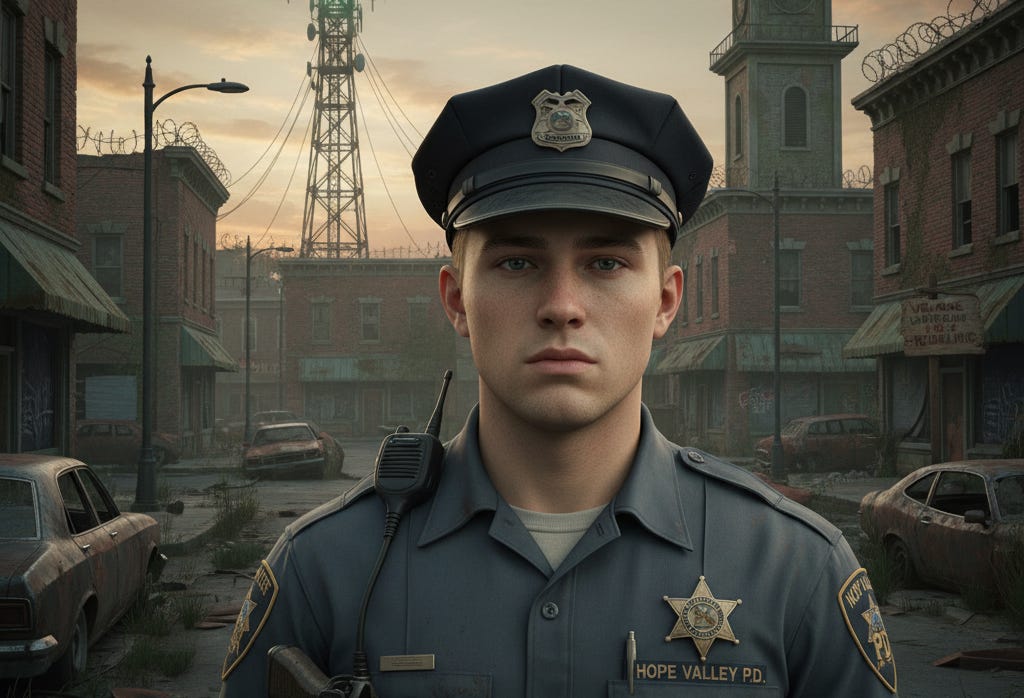
Initially, I was thinking in terms of a story where an outsider comes into town and gets into a clash with a cop over a minor traffic violation, like speeding or running a red light. But I quickly tossed that idea out. It felt far too cliché, like a Rambo-style scenario where a "good guy" is up against an "asshole cop."
I realized pretty swiftly that I didn't want the cop to be a villain. I wanted him to be an idealist, someone who, like the characters in Neville Shute's On the Beach, desperately clings to tradition and the old ways even when disaster is looming. He genuinely believes in maintaining law and order, seeing the global catastrophe as just a temporary problem. Like a classic wartime Brit, he’d have that "stiff upper lip and keep calm and carry on" attitude. What I wanted was to create a character who's almost a tragic hero: ambiguous and maybe misguided, but also standing up for tradition and the law.
Then I took a step back, and started thinking about his age and experience. Would he be an old, seasoned officer or a younger, more idealistic one, fresh out of the academy, hoping his efforts to maintain order would be recognized once things got back to normal? I played around with various ideas, but none of them quite worked.
So then I switched perspective from character to plot. Where was the conflict in the story going to come from? After I rejected the "outsider" idea, I considered a conflict with the town's leadership, maybe him trying to set himself up as the leader on the grounds that he was the representative of the law. But that felt too much like a pulp Western, and not where I wanted to go. I was getting nowhere.
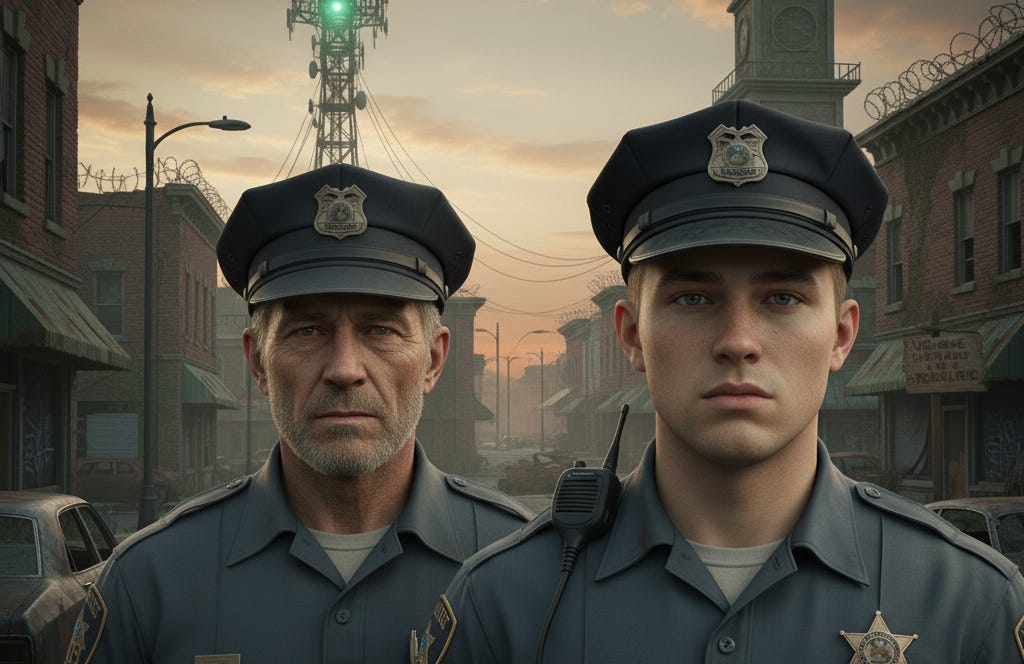
Then I had a breakthrough: what if there were two cops? An old one and a young one, maybe even a father and son? That’s a classic trope for small-town cops, and it offered me an interesting dynamic to play with. Both characters would initially be stuck in their old ways, but one of them would slowly come to realize they needed to change. This generational conflict would represent different approaches to the law, giving me possibilities for character development and different endings. It could be either of them who changed: the obvious thing was to have the young guy change, but maybe it could work to do it the other way.
This approach also allows me to build a narrative around the central theme I wanted to write about: traditionalism versus progressive law. Both perspectives are valid in their own way, but there’s a huge tension between them. And of course, that’s at the heart of so much of the chaos of today’s world: should we be guided by the laws and traditions of yesteryear, or should we adapt? By having two characters, I can represent both those views in an honest and sympathetic way, and then use that to take the reader on an emotional journey.
And with that, just before dawn one morning in August, it all fell into place.
The Cop Story
The story starts out in a seemingly normal world. We see a cop arresting someone for something minor, like running a stop sign. Nothing special, but then you get what my friend Jason Edwards calls the "wait… what?" moment. We find out the entire world has gone to hell. I’m not sure exactly what’s happened, maybe a pandemic or zombies or aliens or the Russians invaded. I’ll figure it out later, but we’re talking a full-blown catastrophe. So now the reader’s going, aw, c’mon, is this guy serious? He’s arresting someone for that, in this situation? That’s insane.
But then we pull out a little further, and put a little more context on it. We see the cop and his dad talking with the perp, and explaining that, look, dude, we gotta have standards. The law is still the law, and last time we looked, this is still the USA, so yeah, it’s tough, but it’s the way it’s gotta be. And, importantly, we find out that he has the support of the whole town. They’re actually managing to maintain a sense of normality despite everything. So now the reader’s thinking, uh, okay, well maybe he’s got a point, he’s not a nutjob.
So then we follow him and his dad around a little, and we see that maybe things are actually pretty okay, given the circumstances. We also learn a little about the guy: he’s fairly fresh outta cop school, and he’s a real idealist. His dad used to be the police chief, but he knows he’s getting too old for it, so his son stepped up to the job. He’s hoping that when all this is over, he’s going to be seen as the savior of the town. We’re definitely not talking Mad Max type world here - at least, not this little bit. So now the reader’s definitely rooting for him. He’s the guy who’s going to rebuild the world, after all.
In the middle of this, we also introduce another key character, his dad’s girlfriend. She’s, maybe a baker or something. I’ll figure that out later. She’s baking bread from her home, and sharing it with the townspeople. Again, I’ll figure out the economy later too. Maybe they have money, maybe they don’t. Not important. She’s a nice lady, would have been retired if all this hadn’t happened, and the son gets on just fine with her. So now the reader’s thinking okay, this is all very cozy. Which means it’s time for WTF number two.
So there’s this other baker in town who wants to get rid of the competition so he can have the entire bakery business. He files a complaint against her because her permit has expired. So the cop, being the by-the-book guy he is, says his dad's girlfriend has to shut down her business. He’s very sorry and all, but well, it’s the law. Can’t run a food operation without a valid permit issued by the state. Health and safety, you see. And since there’s no functioning government to issue new permits… well, you see how it is. And now the reader should be flipping completely. Aw, c’mon, man, that makes no sense at all. Don’t be an asshole.
She, of course, ignores him. She is, after all, providing food for the people, and as far as she’s concerned, that’s way more important than some stupid piece of paper that she can’t possibly get anyway. If she stops baking, people in town will starve because the rival baker can't possibly make enough food for everyone. But the cop says he can’t make any exceptions, especially as she’s involved with his family, which looks corrupt if he lets it go. He tells his dad to go and see her, and if he can’t persuade her to shut up shop, he’ll have to arrest her. So now we’ve come full circle: this law makes no sense in this world, and enforcing it is stupid.
Of course, his dad isn't having it. It’s showdown time. He calls a town meeting. The young cop talks about how important it is to follow the law no matter what, and at first, a lot of the townspeople reluctantly agree, thinking that even a dumb law is still the law. But then, his father stands up and declares the law "really fucking dumb." He points out there's a huge difference between what is legal and what is right, especially when legal action is "stupid and dangerous" to the town's very survival.
The ending is still up in the air, but I could go various ways. Maybe the cop is persuaded by his dad to bend the law for the good of the town. Or, he could refuse to budge and end up arresting and jailing his own father, holding strong to his belief that "the law is the law," no matter what. Or the townspeople decide that bread is more important than the permit so they fire the young cop and reinstate his dad as police chief. I’ll figure it out when I get there. It’ll probably depend what mood I’m in on the day and how I want the reader to feel.
Writing The Cop Story
That whole outline took me literally seven minutes. What you just read was the (almost entirely unedited) transcript of something I dictated to my phone while baking bread (which is probably where the baker idea came from). I now have the whole story in my head.
Over the next few months, I’ll keep working on this in NotebookLM, adding detail, fleshing out bits of the story and so on. I can already see most of the characters and several of the locations, and I can just about hear the way they talk. Some of the scenes feel almost ready to write. Others are still hazy. I still, for example, have no idea what exactly happened to the outside world and why these guys were unaffected. (That may not ever be explained in the story, but I need to know.)
By the time the snow falls, I’m hoping to have the entire thing roughed out. It feels like it’s going to be maybe 10,000 to 15,000 words, more of a novelette than a short story.
And then some weekend when I have nothing else to do, I’ll sit down and write it. It’ll probably take me two days, but the hard work of building the story will already have been done. It’ll just be a typing and editing job at that point.
I got "in trouble" once at a writing group where we were told to go on an "artist's date" and I said how walking my dog was my artist's date because I spent time making up poems and stories. But because I had nothing to "share with the group" I was told I'd "got it wrong."
Guess what? I left that group :)
One of the projects I was noodling around with a few years back was a police officer in Nazi Germany who is investigating a series of murders. He's just regular Kriminalpolizei and has no interest in politics, no prejudices, he's just a career cop. But the absurdity of chasing one murderer while the entire state is dedicated to horrendous crimes on a global scale gradually dawns on him. I couldn't think what to do with it, but I like the way your story takes a really small issue, the baking licence, and makes that the focal point of the whole theme, kind of like Ibsen's Enemy of the People or Willy Russell's Terraces.