
Shorter books, please!
A story’s quality or literary power is not determined by its page count


As you probably know, I read a lot of books: usually somewhere around three or four books a week. But that’s becoming increasingly exhausting. More and more of the books I’m picking up are clocking in somewhere between five and seven hundred pages. Several of them are over a thousand pages. That’s a lot of reading - and a lot of work.
Books that length demand a hell of a lot of commitment from the reader. I’m fortunate in that I read ridiculously fast, but assuming you read at a normal pace, roughly 200 wpm, that’s 15-20 hours for a 700-page book - roughly equivalent to two complete seasons of a typical TV show. If you’re a casual, slow reader, reading maybe 10-15 pages a day before going to bed, it’ll take you two or three months to get through a single book.
Not only that, but more and more novels are written as part of a series. You’re not just signing up for one 700 page book. You’re signing up for five or six books. That’s an even bigger commitment.
This explains why a lot of people simply don’t read anymore. The books are too big and they’re too daunting.
Now, I understand that some of this is due to publishers and the inherent costs of making books. There’s a unit cost to printing and distributing and marketing a book, regardless of size. It’s like a soda in a cinema: the large is only a dollar more than the small, because the amount of soda isn’t a significant price factor.
The thickness, like the size of the soda, is a key selling point. Most people don’t feel happy paying $15 bucks for a thin book, but they will pay $15 to $18 a big fat doorstop of a book. They want to feel the weight, and feel the value. In addition, the spines of thicker books stand out on bookstore shelves, so they’re more likely to get picked up by casual browsers. Therefore, in order to appeal to buyers and still be economical, publishers actively want those books to be as big as possible.
It’s also, I suspect, something to do with our current style of storytelling. We like big, complicated novels with extensive world building, lots of characterization and back story, and lots of plot with lots of twists and turns everywhere. The more complex the book is, the longer the book is, the most seriously we take it. Readers and reviewers demand depth, detail, and richness.
But I don’t think it has to be like that. I recently picked up the Deathworld series by Harry Harrison. I actually got the whole trilogy in one volume, because that was what they had in my local library. All three books came to under 450 pages. The first book was about 130 pages long. Books 2 & 3 were very slightly longer. I ripped through each of them in a morning while sitting in bed with a cup of coffee - before starting work.
It got me thinking back to the books that I used to read as a young man. Most sci-fi, thrillers, Westerns, spy novels, detective stories and so on were about 200 pages: often, much less. 150 pages wasn’t unusual. In many cases, they weren’t long series: they were simple standalone novels. You could read them in an evening, no problem. You could read two or three on a rainy Sunday. You could read an entire book while commuting across London and back on the Tube.
I miss those days.
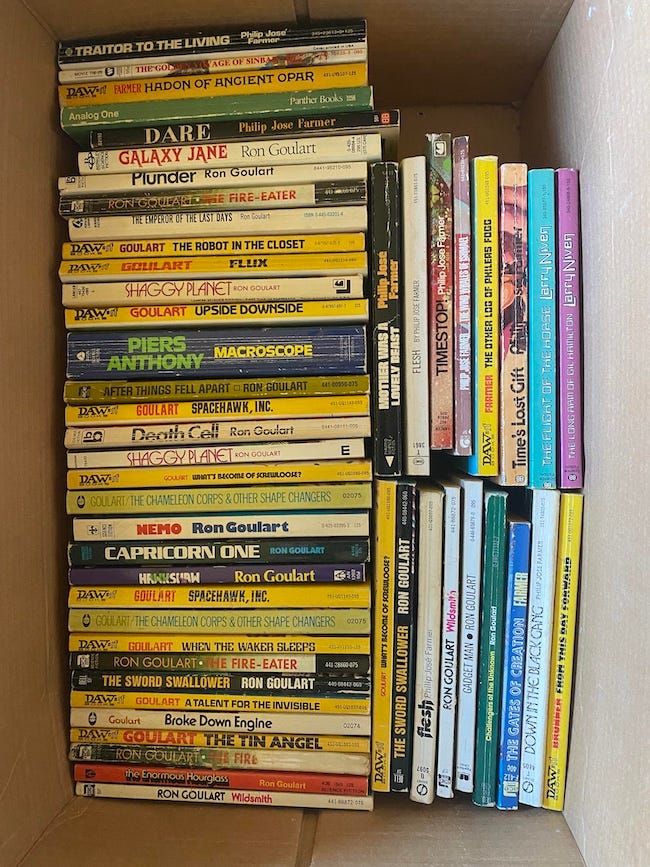
One of the things I really like about self-publishing and ebooks is that it became economical to publish short works, short novels, novellas, novelettes, all the way down to individual short stories.If you’ve only got 100 pages worth of material, you only need to publish a 100-page book. You don’t have to worry about whether that makes sense in terms of the printing and distribution costs.
But too many of the self-published books that I read drag on and on, as if the writer is trying to show us that they’re a serious author because they’ve written so many words. I keep wanting to tell them that if they got rid of two-thirds of the book, it would be so much better. It’s like when someone tells you an anecdote and feels the need to give you every little bit of background information along the way, and by the time they get to the punch line, you’ve lost interest.
In my own work, I deliberately try to write short. I love writing short stories, and I enjoy the challenge of conveying an idea in as few words as possible. I don’t think Yellow Flowers needs to be more than about 70,000 words, and I’ve been ruthlessly cutting out whole sections. I could add a lot more to it and make it twice as long, but what’s the point? I’m just asking for a bigger commitment from my readers, which means there’s a greater chance they’ll give up.
Epics have their place, but I’d love to see more shorter books, both in print and digital. Let’s get back to short entertaining reads.
I'm finding I can't read as fast as I used to and can't do those marathon afternoons reads. I need to take a break to walk dogs, make a drink, doodle about a bit. I've just one a 650+ fantasy fiction - brilliant story - but there was on bit that I wasn't quite sure why they were doing what they were doing because the preamble was at the start of the book! [could probably have put this post on your "brains at rest" post too]
I wish if people wanted to write big epic stories they would just break these massive tomes into trilogies of small books like a normal person.