
How to write eight million words (and counting)
Productivity lessons from Brandon Sanderson

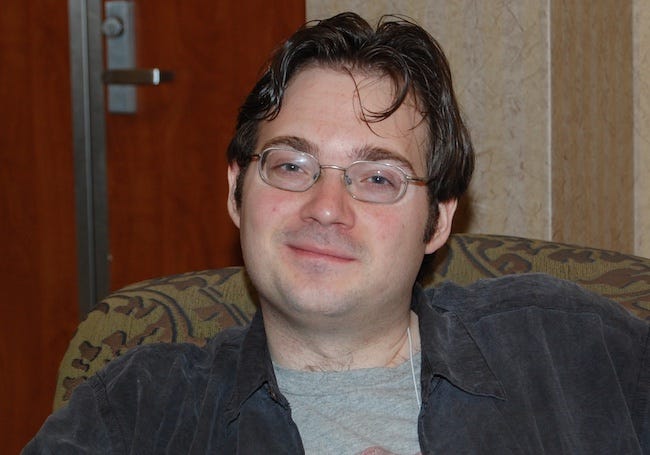
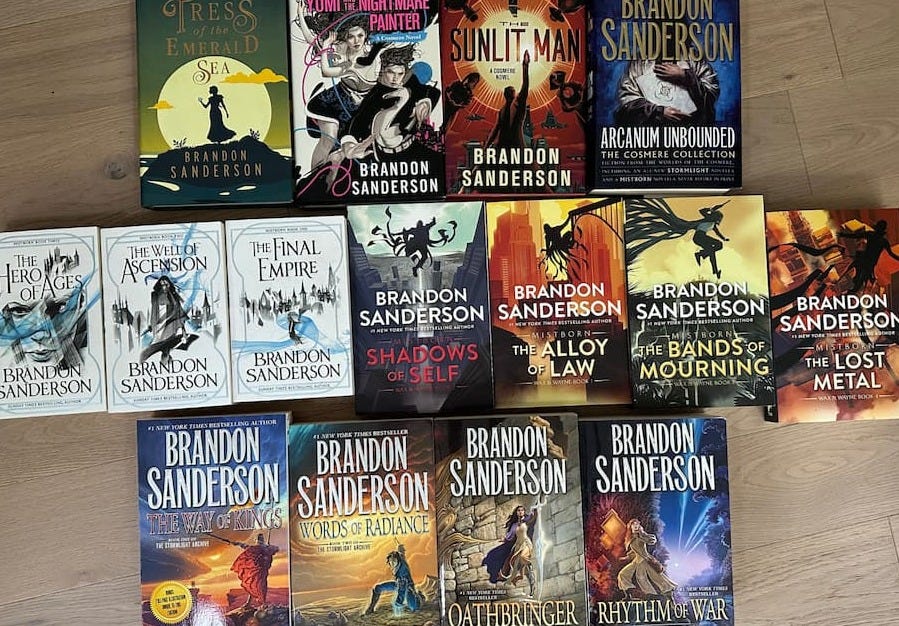
If you’ve been reading my Substack for any length of time, you’ll have noticed that I’m a huge admirer of Brandon Sanderson. He writes some of the best and most imaginative fantasy out there, and he’s an absolute master of world-building. And he’s also quite ridiculously prolific. He doesn’t just write a lot of books - 39 novels so far, and around 30 novellas, short story collections and graphic novels - he writes long books. A thousand pages is normal for him. The five volumes of The Stormlight Archive books are all 1300 pages, and the type gets smaller in each volume.
Completing The Wheel of Time, for which he wrote close to a million words, was just a warm-up. The Cosmere sequence alone is well over five million. Add in his other novels and short stories, and he’s so far written (and published) over eight million words, or 25,000 pages. To put it in perspective, that’s roughly twelve times Tolkien’s entire output. Wind and Truth, his most recent novel, is around 490,000 words, roughly the same length as LotR and The Hobbit put together. (Incidentally, this is why I’m not enthused about the recent announcement that Apple has bought the rights to make movies and TV shows of Cosmere. There’s no way they’ll get through the whole story before it gets canceled.)
Eight million words sounds unbelievable, but it’s actually much more achievable than you might think. If you were to write 1,000 words a day, which is not unreasonable for an experienced writer, it would you take roughly 22 years - 8,000 days - to write that much. (Or, if you prefer, 1500 words a day, five days a week - it comes out almost exactly the same.)
And, as it happens, Sanderson has been writing for roughly 22 years: Elantris was published in 2005. A thousand words a day, every day, and he never lets up.
A couple of recent pieces called How to write like Brandon Sanderson and Inside The Council of Wizards gives some insight into his creative process. There’s a lot of great stuff in it, but there were three aspects in particular that I liked.
Focus on one thing
Most of us have a whole bunch of ideas for stories. But if you keep dashing between them, you’ll never get anywhere with any of them. Pick one, and work on that one exclusively until either you’ve finished a complete draft (or edit, or revision), or you decide it’s not working and ditch it.
The main reason for this, he says, is to keep your subconscious on track. Most “writing” doesn’t happen when you’re at your desk. It happens when you’re doing other things, kicking ideas around in your head, trying to solve plot or character problems, thinking about structure or phrasing, or when to start foreshadowing something you’re going to lean on later. The more time you can spend thinking about your story, the easier it’ll be to write it when you finally sit down at the keyboard. So don’t clutter up your non-desk time with thoughts about other projects. Just immerse yourself in one world, in one story, at a time.
“You've got to train your brain not to squirrel off to the next cool thing that you haven't done. Your artistic inclinations will cause you to want to pursue a lot of different interesting things, and that's one of the differences between becoming a pro and being a hobbyist: The pro sits down and says, No, I'm going to finish the thing I'm on before I can do the next new cool thing.”
Write to music
But, of course, unless you’re a Buddhist monk, training your brain isn’t that easy. And we all have other things we need to do: you may be working on one book, but then you need to jump in and make edits to another. Or, for 99% of us, you have a day job and a family.
Sanderson uses music to keep his brain on track. When he’s working on a project, he exclusively listens to one type of music. If he switches to working on something else, he switches to a different type of music. Then when he’s ready to get back to his main project, he puts on his current “writing music”, and he’s instantly right back in the zone.
I love this concept, and I’ve found myself doing the same without realizing it. I’m going to try being more intentional about this: not so much in the sense of saying “I will always listen to X when writing Y,” but in the sense of disciplining myself to say “I will only listen to X when writing Y.” That way, as soon as my brain hears X, it’s triggered to start thinking about Y. (Important rule for choosing writing music: instrumental only. Lyrics mess up my ability to construct sentences.)
“Becoming a novelist is more about learning your process than it is about finishing any one book. You learn the realities of the business, and you learn how your brain works.”
Don’t do it alone
Writing is, for the most part, a solitary pursuit. But it doesn’t have to be. Sanderson has a team: he has a “vice president of narrative” and an intern who are there for him on a daily basis, acting as a sounding board. As far as I know, he still writes all the words himself, but he has someone on hand full-time to bounce ideas off, help him resolve tricky plot points, or double-check that he’s being consistent. (Which, when you’re writing something on the scale of Cosmere, is challenging.) In addition, he has his “Council of Wizards”, a group of three people who he can call on for advice, feedback and suggestions.
There will be some who howl in protest at this: it’s writing by committee, or it’s not all his own work, or whatever. That’s absurd. The auteur who does literally everything is common in the self-publishing world - which, I contend, is the reason why so many self-published books are crap. Most professional writers have a team behind them: fellow writers, beta readers, developmental editors, and so on. It’s okay to ask for help, comments, or ideas.
(Side note: I was amused by a comment in the introduction to Rhythm of War, where he thanks his beta readers. He notes that he hears from a lot of fans wanting to be part of that team, and points out that it’s “not the sweet gig you might think it is.” Short turnaround deadlines, reading half-finished work, often full of errors, and it may well spoil your enjoyment of the finished book when it comes out a year or more later. Being a beta reader isn’t the same as getting an advance copy.)
A Hollywood scriptwriter once told me that you could tell who was a wannabe and who was a professional easily. The wannabes were very secretive about their work, fearful that someone would steal their brilliant idea. The pros would talk about it to anyone and everyone, because that’s how you find collaborators and get things made. (Unless they were under NDA - but that’s a whole different story.)
I’ve certainly felt the difference now that I’m back in a writing group after a few months’ hiatus. I’ve got the motivation to keep writing, and it’s great to get regular feedback on what’s working and what isn’t. I don’t always agree with their suggestions, but it’s always useful to get the readers’ perspective.
I’d love to think I could write a thousand words a day. If I didn’t have to work for a living, I probably could: when I get a good flow going, I usually have no problem writing a few thousand words in a session. Right now, I’m “between engagements,” as actors have it, so I’m certainly going to try to get back to that.
But whether I have the same level of self-discipline as Sanderson to do it day after day after day… that’s a whole different question.
A fine essay on writing loooong stories, Matt. Sanderson has never been a favorite of mine, but I can see how his method leads to lots of books being published. Fascinating story.
That Hollywood scriptwriter clearly never worked with the BBC. Spike Milligan had the right description for them.